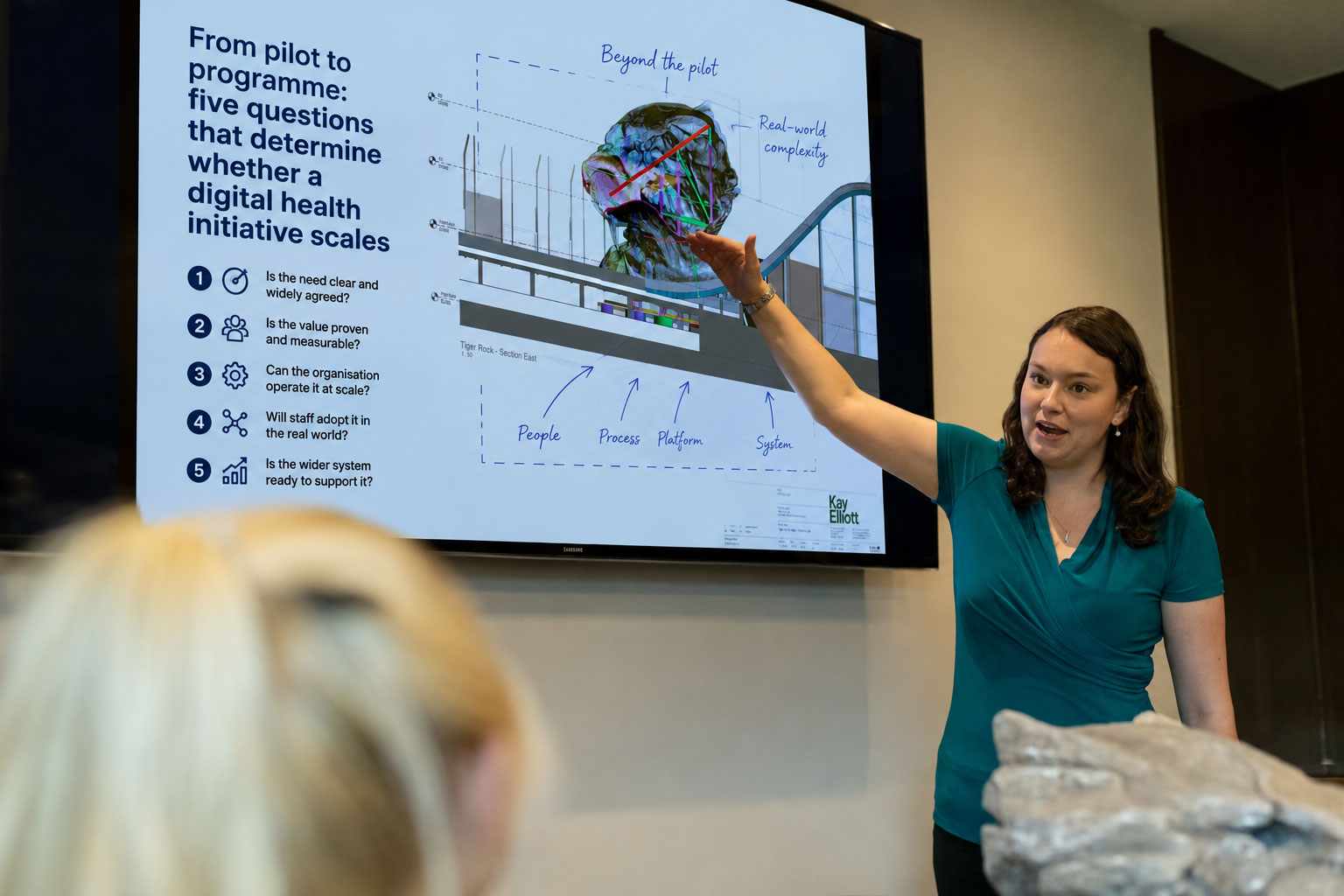

The pilot went well. Engagement was strong and the clinical team liked the platform. The evaluation ended with a recommendation to continue. Eighteen months later the initiative is still running with the same fifty patients, or it has quietly stopped, and nobody can say exactly when the momentum went.
The pattern is common enough that the research literature has a name for it. Huang, Blaschke and Lucas wrote about pilotitis in Globalization and Health in 2017, describing digital health interventions that were adopted enthusiastically by providers and patients yet never gained the acceptance needed to become part of how a health system routinely works. Their case studies came from China and Uganda. The diagnosis applies just as well to a private hospital group in the UK or an insurer in the Nordics.
Why success in a pilot predicts so little
Trisha Greenhalgh and colleagues built the NASSS framework, published in the Journal of Medical Internet Research in 2017, after studying why health technologies fail to move beyond early adoption. Their central observation is that sustained adoption depends less on the technology itself than on the complexity surrounding it: the condition being managed, the value proposition, the staff expected to change how they work, the organisation and the wider system. The more of those domains that are complex, the more likely the technology is to be abandoned.
A pilot is engineered to suppress that complexity. It runs with hand-picked staff, a project manager whose whole job is to remove obstacles, and a patient cohort often recruited for willingness. Scale removes each of those supports and adds volume at the same time. A successful pilot therefore answers the question of whether something can work under favourable conditions. It says very little about the question buyers need answered, which is whether it works as a permanent part of the operating model.
Five questions worth asking before the contract is signed
In conversations with prospective partners across hospitals, insurers, employers and public health systems, Liva's commercial team hears the same concerns surface again and again. The organisations that scale successfully tend to be the ones that asked a particular set of questions early.
- What would delivery look like at ten times the volume? If the honest answer is ten times the clinicians, the initiative has a staffing plan rather than a scaling plan. The delivery model itself has to change as numbers grow, through asynchronous contact and automated routine follow-up, or the economics stop working.
- Who is responsible for engagement after the novelty wears off? A frequent assumption among buyers is that a digital tool generates engagement on its own. In practice, sustained engagement comes from structure: scheduled contact with a named coach, and goals that are set and reviewed rather than left to the app. If nobody owns that structure, engagement decays, and the programme's outcomes decay with it.
- Does this run inside your existing pathways or beside them? An initiative that requires clinicians to work in a parallel system survives on goodwill, and goodwill is finite. Labrique and colleagues, reviewing real scaling cases in Globalization and Health in 2018, found that simplicity and interoperability were among the factors that decided whether digital health initiatives scaled, and that these were set long before scale-up began.
- Are you buying software, expertise or delivery? These are different purchases with different implications for your own workforce. Some organisations want a platform their teams deliver through. Others want programmes designed and delivered for them. Trouble tends to arrive when a buyer procures one and expects the other, and the question is worth settling before implementation rather than during it.
- What does month thirteen look like? A programme needs a budget line, an owner, ongoing governance and an evidence plan that satisfies whoever signs off on continuation. In the UK, NICE's evidence standards framework for digital health technologies, updated in 2022, sets out the evidence commissioners can expect a technology to produce. An initiative that cannot generate that evidence in routine operation will struggle to defend its budget, whatever its pilot showed.
How Liva approaches the move from pilot to programme
Liva structures implementation in three phases. Discovery and alignment agrees pathways, stakeholders and success criteria before configuration begins. Configuration and enablement then covers platform setup, integrations, white-labelling and training, and go-live is followed by a period of hypercare with regular reporting and quarterly reviews. The Liva Engage platform is built for delivery at volume, with a patient experience layer, a clinician and operational layer, and an analytics and governance layer that gives partners visibility of engagement and outcomes in routine operation. Programmes are delivered by certified health coaches, among them dietitians, nutritionists and psychologists, using the COM-B behaviour change framework, with the same clinician staying with a person throughout the programme. Liva is DTAC certified against NHS assessment standards and currently supports more than 68,000 members in 22 languages.
The gap between a promising pilot and a working programme is rarely closed by the evaluation report. The organisations that close it are the ones that treated scale as a design requirement from the first conversation.
Planning to move from pilot to programme?
If your digital health initiative has proved its value in a pilot, the next question is whether it can live inside routine delivery.
Speak to our implementation team about what needs to be in place before you scale.