
Almost all digital health programmes look healthy in their first fortnight. The sign-up numbers climb, the launch dashboard fills with green, and the early activity charts suggest something is working. Then the second month arrives and the same charts tell a quieter story. Logins thin out. Messages go unread, and the people who needed the programme most are often the first to drift away.
Buyers of digital health know this pattern, even when vendors prefer not to mention it. A clinic operator or an insurer signing a population health contract is rarely worried about whether patients will download an app. They are worried about whether anyone will still be using it in six months, because that is the point at which clinical change actually accumulates.
The drop-off problem is structural, not incidental
Attrition is not a flaw that one product happens to have. Gunther Eysenbach described it as a defining feature of digital health back in 2005, when he proposed what he called the law of attrition in the Journal of Medical Internet Research. His argument was that a substantial share of users abandon any eHealth application before they complete it, and that the field had been quietly treating this as an embarrassment rather than a problem to study.
Two decades later, the objective data confirms how steep the curve can be. Amit Baumel and colleagues analysed real-world usage across a panel of mental health apps and found a median 30-day retention rate of 3.3%, published in the Journal of Medical Internet Research in 2019. Most people who install a health app have stopped opening it within a month. A download is not a patient, and an active user in week one is not the same as an engaged patient in month six.
This matters because the clinical evidence for behaviour change depends on people staying long enough to change. In the Diabetes Prevention Program, the trial reported by Knowler and colleagues in the New England Journal of Medicine in 2002, a structured lifestyle intervention cut the incidence of Type 2 diabetes by 58%. That result came from sustained contact and repeated coaching sessions over years, not from a single moment of motivation. Engagement was the mechanism behind the outcome rather than a vanity metric.
What the data shows about who stays
Liva has supported more than 68,000 members across its programmes, in 22 languages, since 2015. Within that membership, a real-world analysis of 3,957 people on Liva programmes found an average weight reduction of 5.5kg, or 5.8% of body weight, at six months. The weight result matters, but the more telling detail is that the cohort was still measurable at six months at all, in a field where most digital tools have lost almost everyone by week four.
Several patterns separate the people who sustain engagement from those who fall away. Early human contact is one of them. When a patient hears from the same coach in the first days, rather than from an automated sequence, the relationship has somewhere to take root. Continuity is another, because a patient who works with one clinician throughout a programme builds a sense of being known that an interchangeable support queue cannot replicate. Realistic goal-setting plays a part too, since patients who are asked to change one thing at a time tend to stay, while those handed a long list tend to disengage quietly.
None of this is automated by the technology alone. The common assumption that a well-designed app will generate engagement on its own is the assumption the retention data contradicts most clearly. Structure and human support are what hold people in a programme long enough for the clinical change to happen.
How Liva approaches engagement
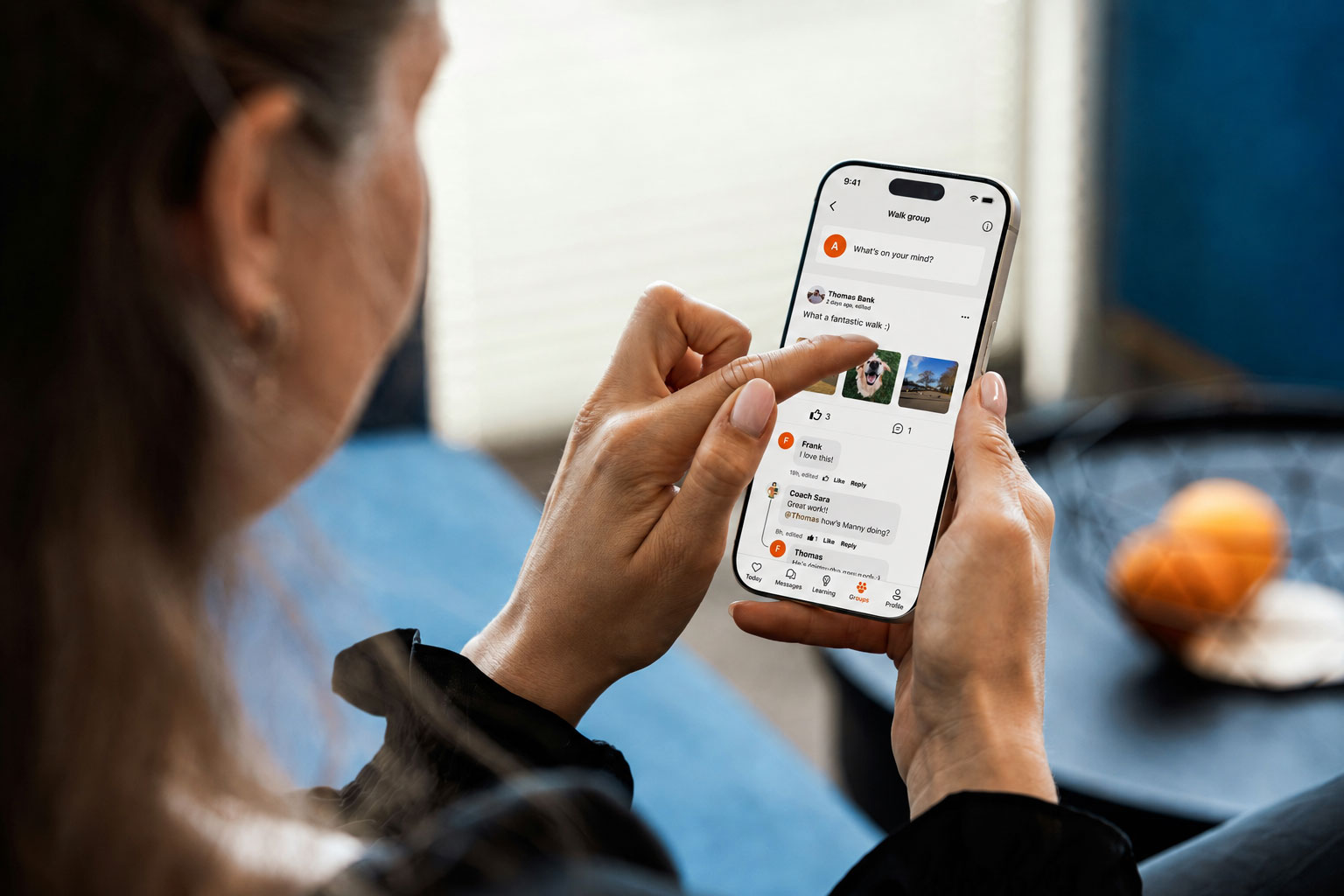
Liva runs evidence-based lifestyle programmes built on the COM-B behaviour change model, which treats capability, opportunity and motivation as the conditions a person needs in order to change a behaviour. Each patient works with the same certified health coach throughout the programme. Those coaches are qualified healthcare professionals, including dietitians, nutritionists and psychologists, rather than general support staff. The coaching is delivered through the Liva Engage platform, which combines app-based tracking and messaging with a clinician portal that gives the coaching team continuous visibility of how each patient is progressing between contacts.
That continuous visibility changes what a coach can do. Instead of waiting for a scheduled appointment to discover that a patient has stalled, the team can see the signal early and reach out while the patient is still reachable. Liva is a registered CQC provider and a NICE approved provider for digital specialist weight management services, and its programmes operate within a clinical governance framework with defined escalation protocols.
Sustained engagement is the part of digital health that does not show up in a launch metric, and it is the part that determines whether a programme produces outcomes or just sign-ups. The organisations that get value from digital care are the ones that treat retention as a clinical design question from the start.
Want to assess whether your digital health programme is designed for sustained engagement? Speak to Liva about retention-led programme design.